How Your Customers Research Before Buying: The 2026 Reality
Aussie business owners, here’s something worth sitting with for a minute.
By the time a customer walks into your shop, books your service, or lands on your checkout page, they’ve already decided whether they trust you. That decision happened on their phone, probably on the couch, maybe at 10pm. They Googled you. They read your reviews. They had a look at your Instagram. Someone on a Facebook group or Reddit thread either vouched for you or didn’t.
You weren’t in the room. But the outcome of that research decided whether you got the sale.
This is the reality of running a business right now, and once you really get it, not just intellectually but operationally, everything about how you show up online starts to matter differently.
Let me walk you through what’s actually happening.
Nobody’s Buying on a Whim Anymore
Cost of living has changed the game. When money feels tight, and for most people right now it does, a purchase isn’t just a transaction. It’s a small risk. And people manage risk by doing their homework.
74% of people name rising costs as a major concern. More than half feel financially insecure. So before your customer spends anything, they want to feel certain. Not just interested. Certain. They want multiple signs that you’re the right call before they commit.
What does that homework look like? It’s not one Google search. On average, shoppers touch 4.8 different sources before making a decision. Your website. Your Google reviews. Your socials. A forum thread. A mate’s recommendation that they then went and verified online anyway.
Think about what that means for your business. If any one of those touchpoints is missing, outdated, or unconvincing, that’s where you lose them. Silently. Without a word.
The Journey Starts Online, Even When It Ends at Your Counter
Over 80% of shoppers research online before buying, including people who intend to buy in-store. So the customer who walked in yesterday and seemed to make a quick decision? They’d already done their research at home. They came in to confirm what they’d already decided.
This is why your digital presence isn’t separate from your “real” business. It is your business, just the part that runs 24/7 while you’re sleeping.
And the numbers back this up. Online retail spending hit $39.4 billion last year, up over 13%. But even for businesses that aren’t selling online, that shift matters. The research is happening online regardless of where the money eventually changes hands. Digital catalogues, price comparisons, reviews, social posts. 71% of shoppers read digital catalogues when considering a purchase. The path to your door now goes through a screen first.
Reviews: The Thing Most Business Owners Underestimate
Let’s have an honest conversation about reviews, because this is where so many good businesses quietly bleed customers.
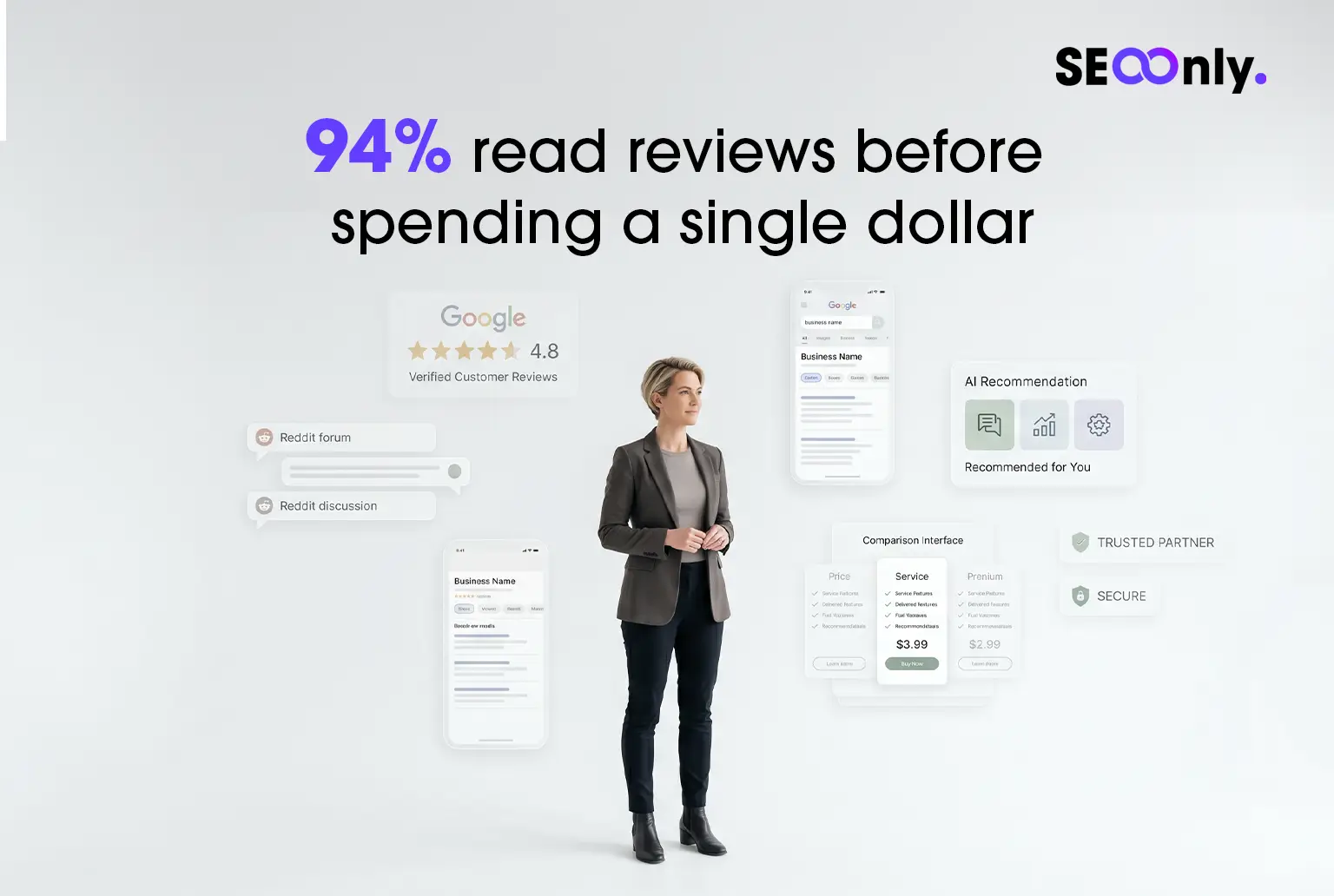
94% of people read reviews before buying. Not sometimes. Routinely, before almost everything. And here’s the part that really matters: 78% trust those reviews as much as a personal recommendation from someone they know. A stranger’s Google review carries the same weight as a mate’s word. That should stop you in your tracks.
Google Reviews is where most of the action happens. 63.6% of shoppers check Google Reviews before visiting a business. But ProductReview.com.au is huge for product-based businesses, Hipages owns the trades space, and TripAdvisor still rules hospitality.
Now, the nuance most business owners miss: people don’t actually trust a perfect five-star rating. 72% of shoppers prefer to see a mix of reviews, a handful of 4s, the occasional 3, and critically, how the business responded. A thoughtful, measured reply to a complaint does more for your credibility than ten glowing five-stars from people who all suspiciously sound the same.
The practical upshot is simple: build a habit around asking happy customers for a review. Put a link in your follow-up email, your invoice, your text message the day after the job’s done. A business with 150 recent reviews will consistently outrank a competitor with 20 dusty ones, and will win the customer before there’s even been a conversation.
Social Media Has Become a Search Engine (Yes, Really)
This one tends to surprise business owners who’ve been doing things a certain way for a while.
58% of people now use social media to research brands and products, almost as many as use Google. For anyone under 40, TikTok and Instagram have effectively become the first place they go when they want to know if something’s worth it. They’re not reading polished product descriptions. They’re watching a real customer unbox something. They’re scrolling the comments to see if people are happy. They’re looking for signs of a real, operating business.
And then there’s Reddit, which has absolutely exploded locally. User numbers grew by 179% in a single year. Why? Because people are tired of content that’s been optimised to within an inch of its life and reads like no human wrote it. They want genuine, unfiltered takes from other real people. If your product or service category is being discussed in local subreddits, those threads are shaping opinions whether you’re aware of them or not.
You don’t need to be everywhere. You need to be somewhere, properly. Know where your customers actually spend time and show up there with content that looks like a real business. Behind the scenes, real results, genuine Q&As. Not a brochure. Not stock photos and corporate captions.
Local Search Is Where Small Business Wins (or Loses)
If you’ve got a shopfront, a service area, or you rely on people finding you in your suburb, this is the one that matters most.
Nearly half of all Google searches have local intent. “Electrician Footscray.” “Best brunch Newtown.” “Physio near me open Saturday.” And 42% of people who found a business on Google Maps then visited that business in person. The map result isn’t just a listing. It’s a direct pipeline to your door.
Here’s the uncomfortable stat: 55% of local businesses still hadn’t claimed their Google Business Profile as of 2023. Which means right now, today, a big chunk of your competitors are invisible in local search. That’s not their problem. It’s your opportunity.
Claiming your profile takes twenty minutes. Adding accurate hours, real photos, your services, and your suburb takes another hour. That one afternoon of admin work can be the difference between showing up in the local map pack or watching a competitor take the customer who was practically already yours.
Mobile Browsing vs. Desktop Buying: The Gap That Costs You Sales
Here’s a pattern worth understanding. 51% of web traffic comes from mobile, but 55% of actual purchases are completed on desktop. People browse on their phones constantly, on the couch, on the train, waiting for a coffee. But when it’s time to actually spend money, many still prefer the bigger screen.
Cart abandonment on mobile is significantly higher, 73% versus 60% on desktop. A slow, clunky, hard-to-navigate mobile experience isn’t just annoying. It’s directly costing you conversions.
Check your own website on your phone right now. Does it load quickly? Are the buttons easy to tap? Is checkout straightforward? If it feels frustrating to you, it’s definitely frustrating to your customers.
And if you’re not offering Buy Now Pay Later at checkout, that’s worth revisiting. Shoppers are 82% more likely to complete a purchase from a site that offers BNPL. Afterpay, Zip, Klarna. These aren’t just payment options, they’re trust signals that say we make it easy to buy from us.
AI Is Quietly Changing How People Find You
This one is still emerging but it’s already real. Around one in three shoppers now uses AI tools as part of their research, asking ChatGPT or Google’s AI summaries things like “who’s the best bathroom renovator in Brisbane” or “is this brand actually worth the price?”
These tools pull from everything that exists about your business online. Your website content, your reviews, forum mentions, social posts. They synthesise it all and surface a recommendation. If your digital footprint is thin or inconsistent, you simply won’t come up. If it’s solid and well-reviewed, you will.
The good news is there’s no separate AI strategy needed here. Strong reviews, a clear website with detailed service descriptions, well-structured FAQs, and accurate business information everywhere. That’s what works for Google, and it’s exactly what works for AI tools too. Same fundamentals, same effort, double the payoff.
So What Do You Actually Do With All This?
The customer journey in 2026 is genuinely multi-step. Awareness, research, comparison, consideration, purchase, and then, if you’ve done everything right, a review that starts the whole cycle for someone else.
Your business needs to show up credibly at each of those stages. That doesn’t mean being everywhere. It means getting the basics right and maintaining them consistently.
Claim your Google Business Profile. Build a system to gather reviews. Post content on the platforms where your customers actually are. Make sure your website works on a phone. Be transparent about pricing. Respond to reviews, all of them.
None of this is expensive. Most of it is free. And the businesses that have quietly done all of this while everyone else has been too busy? They’re the ones winning customers before the conversation even starts.
Sources: Executive Summary Report (Australian Consumer Research Channels 2026); Resonate CX 2025 Shopping Behaviour Research; DataReportal Digital 2026; Roy Morgan Research; ACMA How We Use the Internet 2024; IAB Australia eCommerce Report 2025; PayPal Australia BNPL Data 2025; Fifth Quadrant Generative AI Search Report; PwC Voice of the Consumer 2025.
Vicky Miller
Writing for SEOOnly on AI search, SEO strategy, and turning search visibility into measurable growth.
Last updated May 25, 2026