Structured Data for AI Search: How Schema Markup Gets You Cited by ChatGPT and Gemini
If you’ve spent any time in an SEO Facebook group or LinkedIn comment section this year, you’ve seen this argument. One camp says schema markup is the single biggest lever for getting cited in AI Overviews and ChatGPT. The other camp, often waving a Google document, says structured data is basically optional theatre. Both camps are quoting real sources. That’s the part nobody tells you.
So, let’s actually dig into it properly. What does Google say, on the record, in its own developer documentation? What have Google’s engineers said off the record, in the messier, more honest forums like Reddit and conference stages? And what does the evidence, the actual controlled experiments, show about whether ChatGPT and Gemini use your JSON-LD at all? This isn’t a listicle of “5 schema types you need.” It’s a walk through the primary sources, so you can make your own call on where to spend your time this quarter.
What Google actually says, in writing
On 15 May 2026, Google published its first official guide to this exact question: Optimising your website for generative AI features on Google Search. It sits inside Search Central, under a new “Generative AI fundamentals” section, next to the SEO Starter Guide. This is as close to a primary source as you’ll get.
Here’s the line that matters most for this article, quoted directly from Google’s documentation:
“Overfocusing on structured data: Structured data isn’t required for generative AI search, and there’s no special schema.org markup you need to add. However, it’s a good idea to continue using it as part of your overall SEO strategy, as it helps with being eligible for rich results on Google Search.”
Read that twice, because both halves matter. Google is explicitly telling website owners not to treat schema as a magic key to AI Overviews or AI Mode. It sits in a section literally titled “mythbusting,” alongside other debunked tactics: llms.txt files, “chunking” content into AI-friendly fragments, and rewriting copy specifically for AI systems. Google says none of these earns you anything extra on Google Search.
But the guide doesn’t say schema is worthless. It says keep using it as part of your normal SEO strategy, because it’s still how you earn rich results in classic Search. And underneath that guide sits a more technical explanation of how AI Overviews and AI Mode actually work, which is worth unpacking because it changes what “helping the AI” really means.
Google’s generative AI features run on two mechanisms:
- Retrieval-augmented generation (RAG), which Google also calls grounding. The model doesn’t answer from memory. It retrieves relevant, indexed pages from Google’s Search index in real time, then generates a response using facts pulled from those pages, with clickable links back to the sources.
- Query fan-out, where the model breaks your one search into several related searches behind the scenes to build a more complete answer.
Here’s the critical detail: to be eligible for any of this, a page has to be already indexed and eligible to appear in ordinary Google Search with a snippet. There’s no separate AI index and no AI-only ranking system. If you can’t rank, you can’t get cited. That’s the whole foundation, and it’s why Google keeps hammering the point that this is “still SEO.”
What Google’s own people say when they’re not writing official docs
Official guides are carefully worded by committee. The more interesting, more nuanced answers tend to come out when Google engineers are talking off the cuff.
John Mueller, Google’s long-time Search Advocate, has fielded this exact question on Reddit more than once, and he’s been careful to flag when he’s speaking personally rather than officially.
Asked directly whether extensive schema markup helps LLMs understand a brand better, or whether it’s purely for Google’s rich snippets.
Mueller wrote: “This question will stick with us for the next year and longer, and the short answer is yes, no, and it depends.”
He explained that it depends entirely on the feature and how a given search engine or LLM actually uses that markup. Some features lean on structured data heavily, shopping results being the clearest example, because pricing, shipping, and availability are, in his words, “basically impossible to read in high fidelity and accurately from a text page.” Other schema types, he added, carry a lot of wishful thinking. Adding insurance-comparison markup to your site isn’t going to make Google, or an LLM, decide you’re the best insurance comparison site.
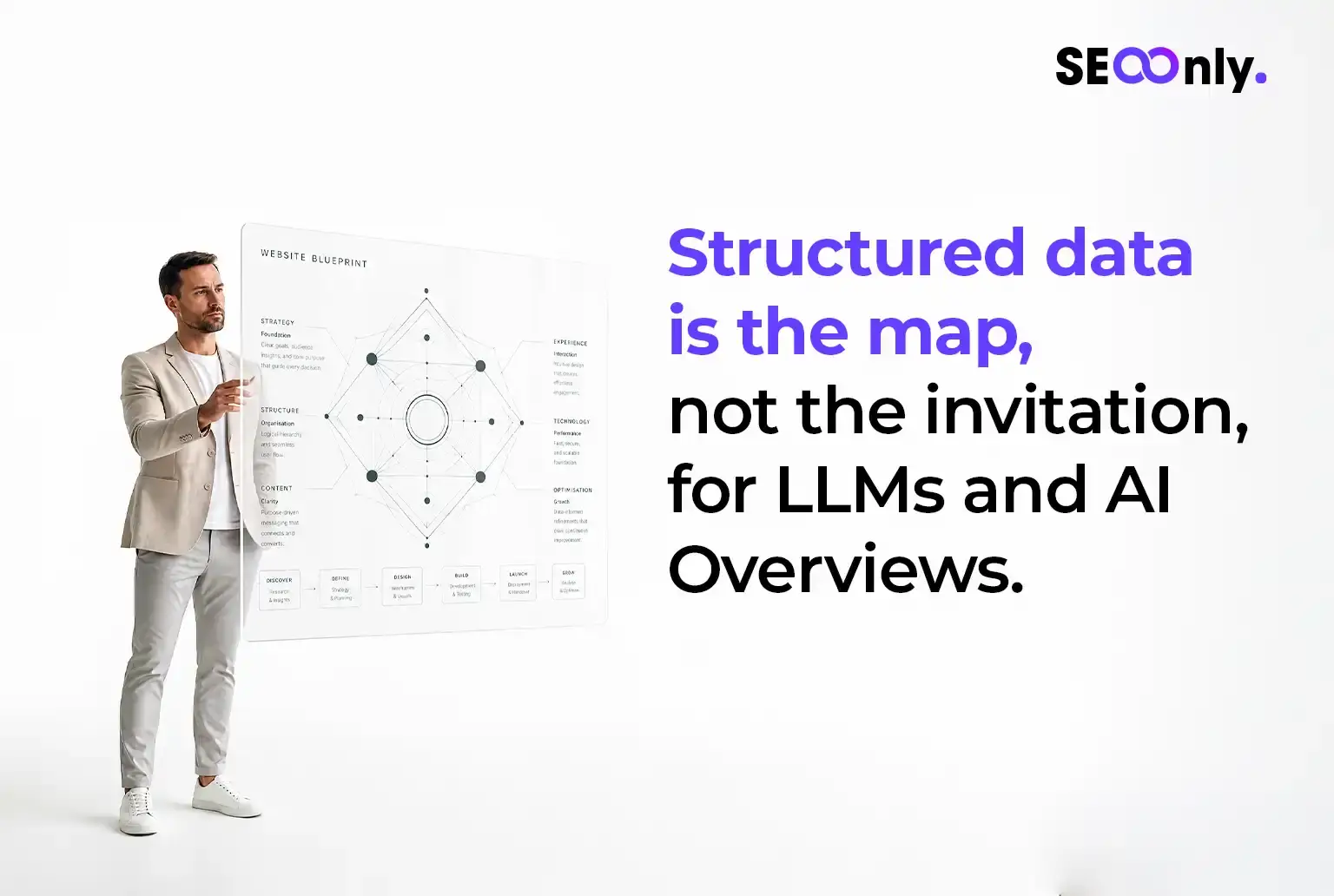
Mueller has also been consistent for years on a separate but related point: structured data has never been a Google ranking factor, and it still isn’t. He’s used a memorable analogy for this: think of structured data as directions to a party. The directions won’t get you in if you were never invited. Ranking factors are the invitation; schema is just the map.
There’s also a lesser-known but very relevant on-record comment from Ryan Levering, a Google structured data engineer, made at a Search Central Live event in New York in March 2025. He said that a lot of Google’s systems run considerably better with structured data present, describing it as a real factor in grounding and scaling Google’s generative AI systems. That’s a technical engineer talking about infrastructure, not a marketer talking about tactics, and it’s a more grounded (pun intended) way to think about schema’s role: it’s plumbing that makes retrieval more reliable, not a lever you pull to unlock a citation.
Put Mueller and Levering together, and you get a coherent, if unglamorous, picture: structured data helps Google’s systems read your page with less ambiguity and less risk of getting a fact wrong, but it doesn’t buy you a place at the table. Content quality, indexing, and topical authority get you the invitation.
How this actually works under the bonnet: Google, Gemini, and ChatGPT are not the same machine
This is where a lot of advice online goes wrong. People talk about “AI search” as one thing, then quote a Google statistic to justify a ChatGPT tactic. The retrieval pipelines are genuinely different, and that matters for what schema can and can’t do.
Google AI Overviews and the Gemini app are both powered by Google’s own search infrastructure, but they’re not identical surfaces. AI Overviews sit directly on top of the live Google SERP and use RAG against Google’s Search index, as described above. The Gemini app and Gemini API use a separate “Grounding with Google Search” tool that, when triggered, runs a live Google Search, retrieves results, and returns a response with inline citations tied to specific text spans. Both surfaces are heavily dependent on Google’s Knowledge Graph for entity recognition, which is the part where structured data does real, demonstrable work. Organisation schema, sameAs links to verified profiles, and consistent entity data across your site feed directly into how confidently Google’s systems can identify who you are, separate from how the RAG layer chooses which page to quote. A stronger Knowledge Graph presence tends to correlate with stronger visibility across both AI Overviews and the Gemini app, because they’re drawing from the same well.
ChatGPT is a different story altogether. OpenAI runs three separate crawlers: GPTBot, which collects training data; OAI-SearchBot, which powers ChatGPT Search results and is the one you actually need to allow if you want to be cited; and ChatGPT-User, which fetches a page only when a user explicitly asks ChatGPT to look at a specific URL. None of them renders JavaScript, so if your content only appears after a client-side script runs, ChatGPT’s crawlers may never see it at all. For live search, ChatGPT has historically leaned on Bing’s index as a search partner, which is one reason Microsoft’s public statements on structured data matter almost as much as Google’s for anyone trying to get cited in ChatGPT.
And on that note: Microsoft has been the most direct of any major platform. Fabrice Canel, Principal Product Manager at Microsoft Bing, said on stage at SMX Munich in March 2025 that schema markup helps Microsoft’s LLMs understand content, referring specifically to Copilot. That’s a named engineering lead confirming it in public, on the record, which is genuinely rarer than the SEO industry’s confidence on this topic would suggest. He also noted that generative AI systems value freshness as a kind of cross-check against their training data and recommended pushing updates through the IndexNow API, so they’re picked up faster.
OpenAI, Anthropic, and Perplexity have not made an equivalent public statement about how, or whether, they parse JSON-LD specifically.
The evidence is genuinely split, and that’s worth sitting with
Here’s where “clear, deep study” means resisting the urge to hand you a tidy conclusion. The controlled experiments that exist right now don’t agree with each other, and the honest answer is that this space is still being figured out in public.
On the positive side, Search Engine Land ran a controlled test in September 2025 comparing three near-identical pages targeting the same query and industry, one with well-implemented schema, one with poor schema, and one with none at all. Only the page with clean, complete JSON-LD appeared in a Google AI Overview. It also achieved the highest organic ranking of the three, hitting position 3. The page with no schema wasn’t even indexed. The researchers were careful to note that this pointed to schema quality, not just presence, mattering for AI Overview visibility specifically, and they didn’t extend the claim to other platforms.
On the more sceptical side, Ahrefs published a much larger study in 2026 tracking 1,885 pages that had schema added, matched against control pages that never received it, measuring citation changes across Google AI Overviews, AI Mode, and ChatGPT. No platform showed a meaningful increase in citations after the schema was added. While Ahrefs’ broader analysis of 6 million URLs showed that AI-cited pages were roughly three times more likely to use JSON-LD, their controlled testing suggests this is merely a correlation with overall site quality, rather than proof that schema directly drives citations.
Then there’s the OtterlyAI experiment, run from December 2025 to March 2026 across seven AI platforms, which asked a more basic question first: can these platforms even read raw JSON-LD when they fetch a page directly? The results were sobering for schema advocates. Perplexity’s bot couldn’t fetch the test pages at all. Claude reported no schema was present, even where it clearly was. ChatGPT’s citations for the test pages actually dropped after schema was added. Only Google’s AI Overviews and AI Mode showed a gradual, modest uptick, and even that partly overlapped with what looked like a broader algorithmic shift rather than a clean schema effect.
A separate, smaller test cited in Search Engine Journal’s coverage (the searchVIU experiment) found that five AI systems, when fetching pages live, extracted only the visible HTML and ignored the JSON-LD, microdata, and RDFa blocks entirely.
How do you square this with Fabrice Canel’s on-record confirmation that Bing’s LLMs use schema? Most likely, the difference is architectural. Platforms with their own search infrastructure and knowledge graphs, Google and Bing, absorb structured data during crawling and indexing, well before any LLM is involved, and that pre-processed understanding then feeds the grounding layer. Platforms without that infrastructure, or that fetch a page live at answer time, are often just reading rendered text, the same way a human would, with the page’s source code hidden. That’s a genuinely useful distinction to hold onto: schema’s value seems to depend far less on which AI model is writing the answer, and far more on whether that platform has its own crawler and knowledge graph doing the pre-processing.
So, does schema get you cited? The honest, practical answer
Structured data won’t get you a citation on its own. Nobody credible, not Google, not Microsoft, not the independent researchers running these experiments, is claiming that. What the evidence does support is narrower and still genuinely useful:
- For Google (AI Overviews and the Gemini app), schema strengthens the Knowledge Graph entity signals that both surfaces draw on, and clean, complete schema appears to correlate with better retrieval and indexing outcomes, even though Google explicitly says it’s not required.
- For Bing and Copilot, Microsoft has confirmed structured data helps its LLMs understand content, making it one of the few platforms where you have a direct, named, on-record statement to act on.
- For ChatGPT, Perplexity, and Claude, the evidence currently points to little or no direct benefit from JSON-LD at the point the model actually reads your page. What matters far more there is crawlability (allow OAI-SearchBot, use server-side rendering, don’t hide content behind JavaScript) and content that states clear, self-contained answers in visible text.
- Across every platform, poorly implemented or mismatched schema, where the markup says one thing and the visible page says another, is treated as a policy violation by Google and, at best, ignored elsewhere. If you’re not going to maintain it properly, it’s better left out.
If you’re deciding where to spend limited hours this quarter, the five schema types with the strongest, most consistently cited case across both traditional rich results and AI-era entity signals are Organisation (with sameAs links to your verified profiles), Article or BlogPosting (with clear author and publisher attribution), Product, LocalBusiness, and, with the caveat that its rich-result value on Google is gone, FAQPage, kept only where the Q&A content is genuinely visible on the page.
Beyond that, the highest-leverage thing you can do isn’t schema at all. It’s the same thing Google’s May 2026 guide leads with: crawlable, indexed pages, written by someone who clearly knows the topic, that Google can retrieve and quote with confidence. Schema is the map. Content and technical health are still the invitation.
Sources
Official documentation
- Google Search Central: Optimising your website for generative AI features on Google Search (published 15 May 2026, last updated 29 June 2026)
- Google Search Central Blog: A new resource for optimising for generative AI in Google Search
- Google AI for Developers: Grounding with Google Search (Gemini API documentation)
- OpenAI Help Center: Publishers and Developers FAQ
- OpenAI Help Center: ChatGPT Search
Reporting on Google engineers’ statements
- Search Engine Journal: Google Is Not Diminishing The Use Of Structured Data In 2026
- Search Engine Roundtable: John Mueller On If Schema Helps With LLMs & Google
- Search Engine Land: How schema markup fits into AI search, without the hype (source for the Ryan Levering, Google structured data engineer, quote)
Reporting on Microsoft Bing’s statements
- Search Engine Land: Microsoft Bing/Copilot use schema for its LLMs (Fabrice Canel, SMX Munich, March 2025)
Controlled experiments and studies
- Search Engine Land: Schema and AI Overviews: Does structured data improve visibility? (September 2025 controlled test)
- Search Engine Journal: Schema Markup Didn’t Move AI Citations In Ahrefs Test (1,885-page controlled study, 2026)
- OtterlyAI: Schema Markup’s Real Impact on AI Search (December 2025 to March 2026 experiment, seven platforms)
All reference links were live and current as of July 2026. Given how quickly search engine guidelines change, it is highly recommended to re-verify all links before republishing; Google alone has revised its structured data guidance twice in the last eight months.
Vicky Miller
Writing for SEOOnly on AI search, SEO strategy, and turning search visibility into measurable growth.
Last updated July 10, 2026